Cart Sign In
How to use LSI keys in text
admin
28-03-2026, 19:28 28 0

How to use LSI keys in text

In modern SEO, it is important not only to use direct keywords, but also to consider LSI keys. They help search engines better understand the content, increase the relevance of pages and improve the site's position in search results. In this article we will look at what LSI keys are and how to use them correctly in text.

1. What are LSI keys

LSI (Latent Semantic Indexing) is a latent semantic index. Simply put, LSI keywords are words and phrases that are semantically related to the main topic of the text, but are not necessarily the same as your direct keyword.

For example, if the main key is “vitamins for immunity”, LSI keys could be:

  • “immune system”,
  • “body protection”,
  • “healthy image” life",
  • "disease prevention".

Using LSI keys helps search engines understand the context of the text and reduces keyword spam.

2. Why use LSI keys

The main advantages of LSI keys:

  1. Increasing text relevance - search engines understand the content of the page better.
  2. Naturality of the text – the text is not overloaded with repeated keywords.
  3. Improved SEO rankings – pages with semantically rich text often rank higher in search.
  4. Attracting the target audience – LSI keys help to reach a variety of user requests.

3. How to find LSI keys

There are several ways:

3. 1 Search suggestions

  • Enter the primary key in Google or Yandex.
  • Pay attention to the autocomplete suggestions and the "Related Queries" section.

3. 2 Online tools

  • LSIGraph, UberSuggest, Ahrefs - help you find semantically related words.

3. 3 Competitor Analysis

  • See what words and phrases are used by sites that rank in the top positions for your keyword.

4. How to correctly use LSI keys in text

4. 1 Natural inclusion in content

  • LSI keys should fit seamlessly into sentences.
  • Do not try to insert them artificially - this may impair the readability of the text.

Example:

  • Main key: “vitamins for immunity”
  • LSI key: “healthy image” life"
  • In the text: "To maintain immunity, it is important not only to take vitamins, but also to lead a healthy lifestyle."

4. 2 Use in Headings and Subheadings

  • Include LSI keys in H2, H3, lists and subheadings.
  • This helps search engines quickly understand the structure and topic of the page.

4. 3 Distribution throughout the text

  • Place LSI keys evenly throughout the text, especially at the beginning and middle of the article.
  • Do not overload the text with a large number of LSI keys - 3-5 natural phrases per 500-1000 words are enough.

5. Tips for using LSI keys

  1. Write for people, not search engines. LSI keys should improve text comprehension.
  2. Use variety: synonyms, words that are close in meaning, phrases.
  3. Update content regularly, adding new LSI keys as audience requests change.
  4. Check your text through SEO tools to make sure LSI keys are included naturally.

LSI keys are an important tool in modern SEO. They help create content that is understandable to both users and search engines. Correct use of LSI keys increases the relevance of the text, improves the site's ranking in search results and makes the content more natural and useful for readers.

Use LSI keywords organically, distribute them throughout your text, and include them in headers to help your site rank effectively and consistently.
See Also

Keywords are the foundation of any SEO strategy. They determine what queries users will use to find your site in search engines. Correctly selected keywords help attract targeted visitors, increase conversions and promote your business on the Internet. In this article, we'll take a closer look at how to choose keywords for your website, even if you're just starting out with SEO. 1. Understanding your site's goals and audience Before choosing keywords, it is important to clearly understand: What products or services you offer. Who is your audience. For example, age, geography, interests. What actions do you want your visitors to take. This could be a purchase, registration, newsletter subscription, etc. The more specific you are about these parameters, the easier it will be to find the right keywords. 2. Creating a Primary Word List Start with a simple brainstorm: Write down all the words and phrases that describe your products or services. Add synonyms, abbreviations,
Image optimization is an important part of website search engine optimization, which directly affects page loading speed, user experience and search rankings. While text content remains a key ranking factor, properly prepared images can help improve site visibility and drive additional traffic from image searches. Why image optimization is important Images can add significant weight to a page, increasing its loading time. Slow websites rank worse and are more likely to be abandoned by users. Additionally, search engines don't "see" images the same way humans do, so they require additional information to understand the content. Competent optimization helps: speed up page loading; improve positions in search results; increase site accessibility; drive traffic from image search. Basic principles of image optimization 1. Choosing the right format Different formats are suitable for different purposes: JPEG (JPG) - for photographs and images with a lot of color; PNG - for
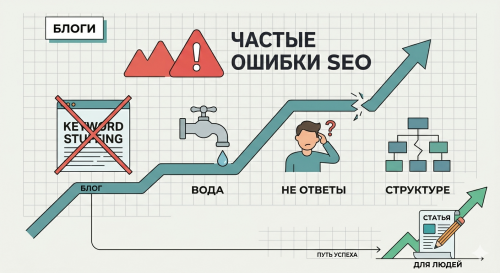
Writing SEO texts in 2026 is not just “stuffing” a page with keywords. Search algorithms have become smarter, they evaluate the benefit to the reader and the naturalness of the language. However, many authors continue to make mistakes that drag the site down. Here are the main pitfalls to avoid. 1. Keyword Stuffing This is “hello” from the 2010s. An attempt to insert the phrase “buy plastic windows inexpensively Moscow” into every second sentence makes the text unreadable. How to: Use LSI phrases (synonyms and thematically related words). Primary key density should be moderate (1-3%). The main thing is that the text sounds natural. 2. Ignoring the user's intent Often authors write a huge longread for the query “how to tie a tie,” although the user needs short instructions with pictures. If the content of the page does not provide a quick answer to the query, the person will leave, and the “behavioral factors” of the site will deteriorate. How to do it correctly: Before writing,
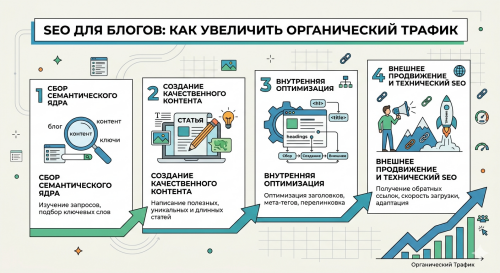
Organic traffic is one of the main goals of any blogger or website owner. It brings a steady stream of visitors without having to spend money on advertising. To increase organic traffic on your blog, it is important to properly optimize your content and consider the technical aspects of SEO. 1. Conducting Keyword Analysis Keywords are the basis of any SEO strategy. For blogs, it is important to select words that users are actually looking for, and not just popular terms. Use tools: Google Keyword Planner, Ahrefs, Semrush or free options like Ubersuggest. Choose low competition keywords: especially for a new blog. Such keywords are easier to rank and can bring stable traffic. Build a semantic core: combine main keys with LSI keys (related terms) so that search engines better understand the topic of the article. 2. Content Optimization Content is what keeps users on your site and keeps them coming back. Headings and subheadings: Use H1 for the main heading, H2 and H3 to structure the
Headings and subheadings play an important role in the SEO optimization of an article. They help search engines understand the structure of a page and help readers find the information they need faster. 1. Use the correct heading structure In SEO there is a hierarchy of headings: H1 - main page heading (used once) H2 - main sections of the article H3–H4 - subheadings within sections This structure helps search engines better analyze the content of the page. 2. Add Keywords It is advisable to include keywords in headings. This increases the page's relevance to the search query. Example: Bad: How to write texts Better: How to write SEO texts for a website But it is important to use keywords naturally and not overload them headers. 3. Make headings clear A good heading should: clearly reflect the content of the section be short and understandable attract the reader's attention If the user immediately understands what a section is about, they stay on the page longer. 4. Break
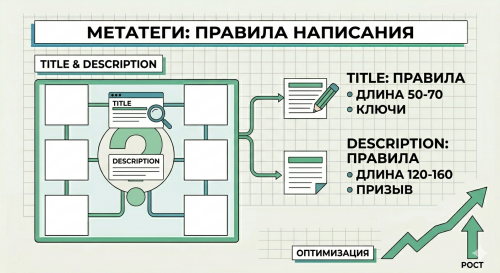
Title and Description meta tags are important elements of on-page SEO optimization. They help search engines understand the content of a page and influence how the site appears in search results. What is the title meta tag Title is the title of the page that is displayed in the browser tab and in search results. This is one of the most important SEO factors. Basic rules for writing Title: length - approximately 50–60 characters the title should be main keyword text should be clear and attractive each page must have a unique Title Example: Bad: Home page Good: SEO website optimization: promotion services and audit What is a Description meta tag Description is a short description of the page, which is often shown in search results under the title. This meta tag does not directly affect rankings, but it does affect click-through rate (CTR). Basic rules for writing Description: length - 120–160 characters briefly describe the contents of the page use keywords make text attractive to the
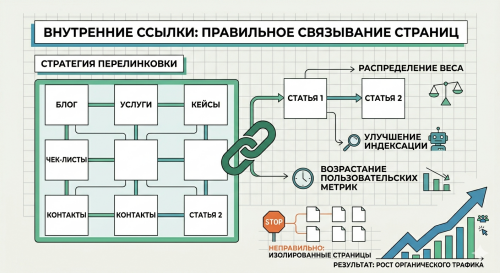
Internal linking is an important element of website SEO optimization. It helps search engines better understand the site structure and makes navigation easier for users. Correct use of internal links allows you to improve the indexing of pages and increase their positions in search results. What are internal links Internal links are links that lead from one page of a site to another page on the same site. They create connections between different sections and help users find the information they need faster. For example, in an article about SEO texts, you can add a link to material about selecting keywords or meta tags. Why internal linking is needed A proper internal linking system provides several advantages: improves the indexing of pages by search engines helps distribute the weight of pages within the site increases the time users spend on the site simplifies navigation between materials The more logical the link structure is, the easier it is for the user and search engines to
SEO text is an article that is optimized for search engines and at the same time useful for the reader. The main task of such text is to help the page rank high in search results and attract more organic traffic. 1. Choose the Right Keywords Before writing an article, you need to determine what queries users are entering. To do this, use keyword analysis services. Pay attention to: query frequency competition relevance to the site's topic It is better to use not only one key, but also additional phrases. 2. Organize your article Search engines love well-structured texts. A good structure includes: heading H1 subheadings H2–H3 lists short paragraphs This helps both search engines and readers understand the content of the article faster. 3. Write for people, not just search engines In the past, SEO texts were often overloaded with keywords. Now search engines understand the meaning of text better. Therefore, it is important: write naturally explain the topic clearly provide useful
The semantic core is the basis of any SEO strategy. It is a set of keywords and phrases that search engines will use to find your site. A properly composed semantic core helps to attract targeted visitors, improve the site’s position in search results and increase conversions. In this article we will look at how to correctly compose the semantic core of a website and what tools to use for this. 1. What is the semantic core The semantic core (SC) is a list of keywords and phrases that reflect the theme of the site and the interests of the target audience. These keys are used to: Optimize site pages. Creating structure and logic of content. Planning advertising campaigns. Example: If you have an online cosmetics store, keywords could include: "buy face cream" "natural cosmetics" "skin care in winter" 2. Determining the goals of the site and audience Before compiling a semantic core, it is important to understand: Who is your target audience (age, gender,

Reviews (0)

reload, if the code cannot be seen


Quick Purchase

Leave your contact details, and we will contact you to complete your order.