

SEO
Practical materials on website promotion and optimization in search engines. Here are instructions and tips on technical SEO, keywords, content, indexing, links and increasing organic traffic.
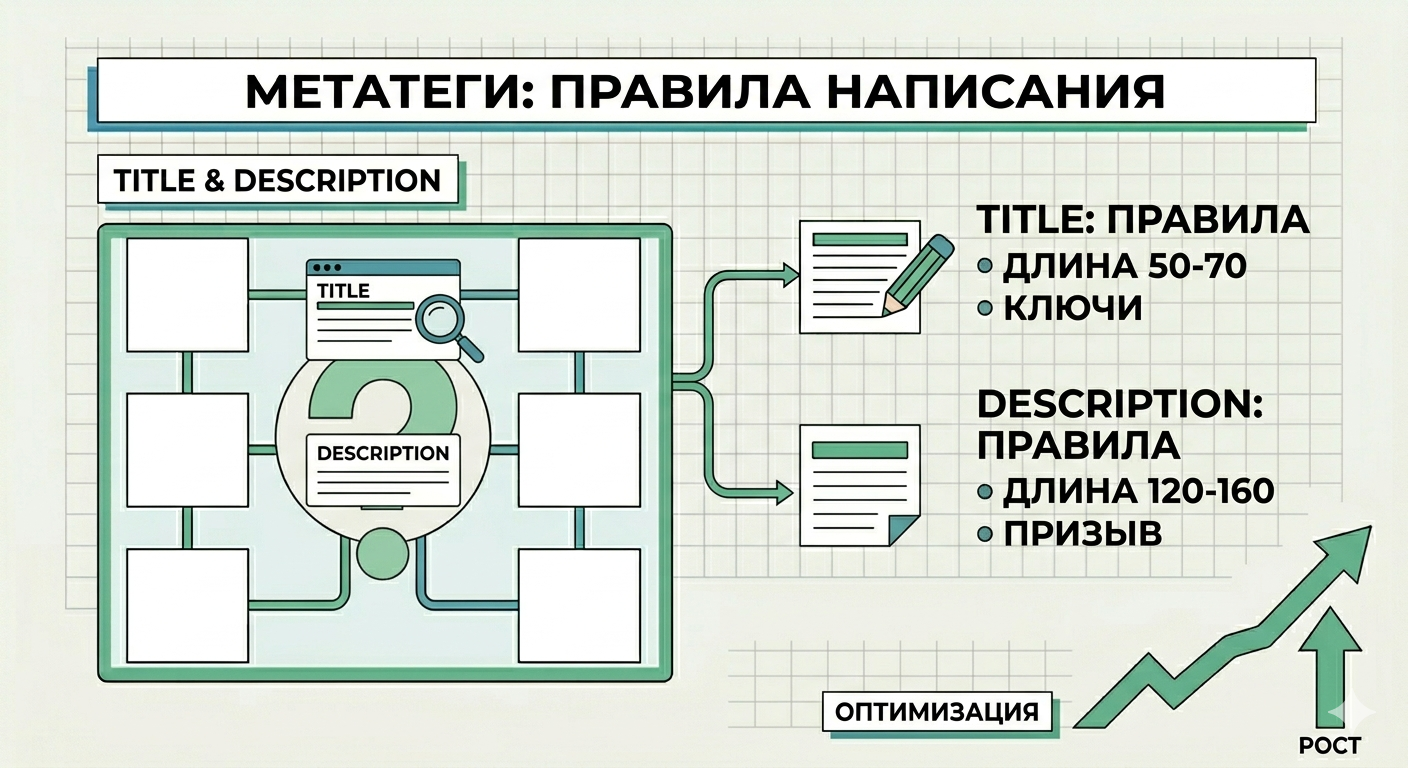
Metatags: title and description, written rules
Title and Description meta tags are important elements of on-page SEO optimization. They help search engines understand the content of a page and influence how the site appears in search results.
What is the title meta tag
Title is the title of the page that is displayed in the browser tab and in search results. This is one of the most important SEO factors.
Basic rules for writing Title:
-
length - approximately 50–60 characters
-
the title should be main keyword
-
text should be clear and attractive
-
each page must have a unique Title
Example:
Bad:Home page
Good:SEO website optimization: promotion services and audit
What is a Description meta tag
Description is a short description of the page, which is often shown in search results under the title.
This meta tag does not directly affect rankings, but it does affect click-through rate (CTR).
Basic rules for writing Description:
-
length - 120–160 characters
-
briefly describe the contents of the page
-
use keywords
-
make text attractive to the user
Example:
Learn how to properly optimize your website for search engines. Practical advice on SEO and promotion.
Recommendations for optimizing meta tags
For meta tags to work effectively, you should adhere to several rules:
-
use keywords, but without spam
-
write unique meta tags for each pages
-
make the text clear to the user
-
add call to action (learn, read, receive)
Common mistakes
When creating meta tags, the following mistakes are often made:
-
the same Title on different pages
-
titles are too long
-
missing keywords
-
description that does not correspond to the content of the page
Title and Description meta tags play an important role in SEO promotion of a website. Well-written meta tags help search engines understand your page better and increase the likelihood that a user will click through to your site from search results.
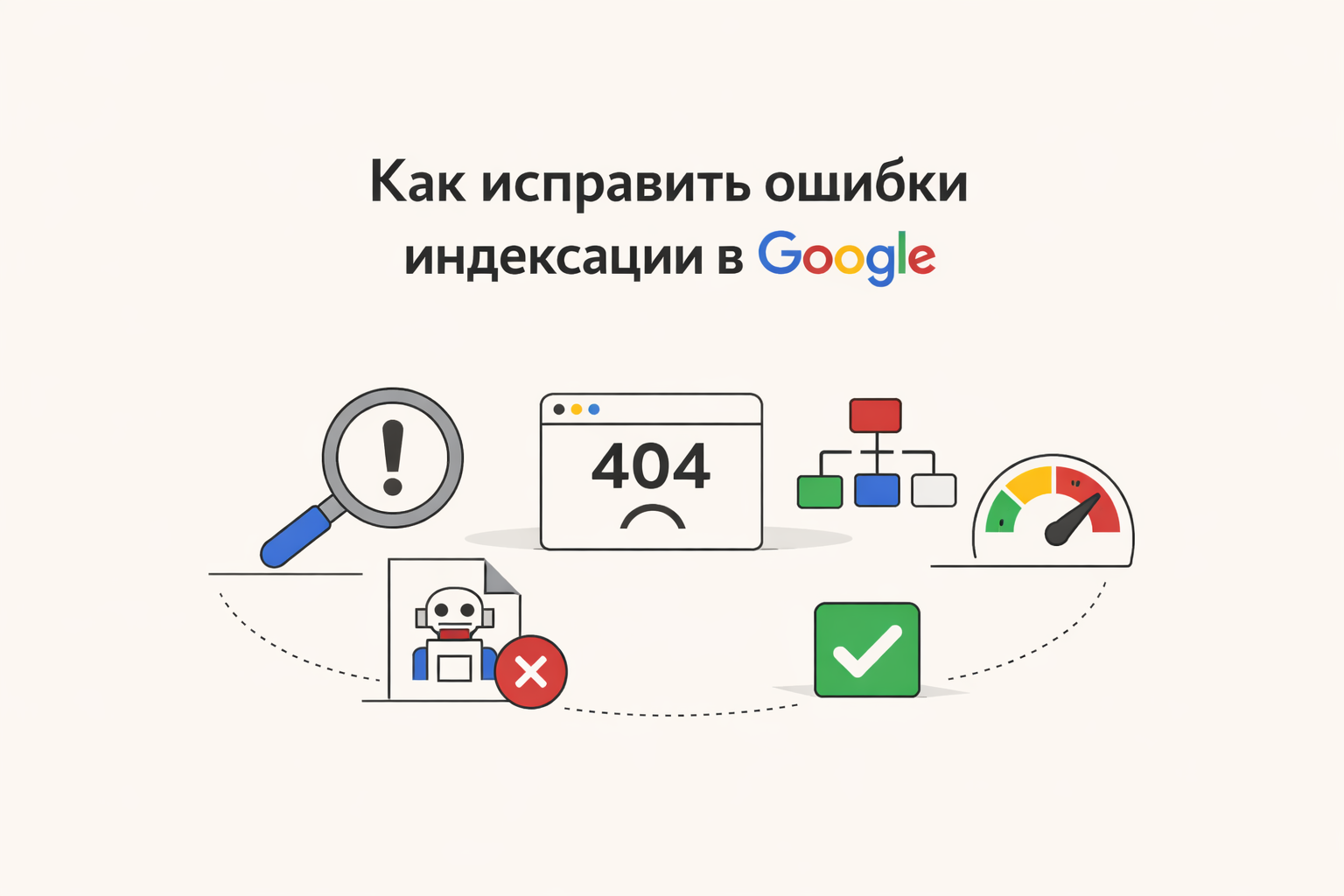
How to Fix Google Indexing Errors
Indexing errors are one of the most common reasons why a website does not appear in searches or loses rankings. If pages are not indexed, they simply do not exist for the search engine. Below is a detailed guide on how to find and fix such problems.
Indexing is the process by which Google Search adds site pages to its database. Only after this they can appear in search results.
Major indexing errors
1. The page is closed from indexing
Check for the presence of the meta tag:
If it is present, the page will not be indexed.
📌 Solution: replace noindex with index.
2. Errors in robots. txt
Robots. txt may prevent crawling:
📌 Solution: Make sure important pages are open:
Allow: /
3. Page not added to sitemap
If you don't have a sitemap. xml, it is more difficult for a search engine to find pages.
📌 Solution:
-
Create a sitemap. xml
-
Add it to Google Search Console
4. Duplicate pages
If the site has the same content, Google may ignore such pages.
📌 Solution:
-
Use tag:
5. Server errors (5xx) and pages 404
If the page does not open, it will not be indexed.
📌 Solution:
-
Fix server errors
-
Set up correct redirects (301)
6. Slow loading of the site
If the site takes a long time to load, the search robot may not wait for it to load.
📌 Solution:
-
Optimize images
-
Use caching
-
Connect CDN
7. No internal links
If no one links to a page, the robot may not find it.
📌 Solution:
-
Add internal links
-
Make a logical structure site
How to check indexing
Through search
Enter in Google Search:
Via Google Search Console
-
Go to section "Coverage"
-
See errors:
-
Excluded
-
Detected but not indexed
-
Error
-
Quick fix instructions
-
Check robots. txt
-
Make sure there is no
noindex -
Add sitemap. xml
-
Resolve 404 and 500 errors
-
Configure canonical
-
Improve site speed
-
Add internal links
-
Submit a page for re-indexing via Google Search Console
Tips for better indexing
-
Publish unique content
-
Update your site regularly
-
Use the correct URL structure
-
Add micro-markup (Schema.org)
-
Monitor server logs
Clean website code and its impact on SEO
Clean website code is properly structured, optimized and understandable HTML, CSS and javascript code. Such code is easy to read by developers and can be processed by search robots without problems.
Code quality directly affects site speed, indexing and SEO rankings.
What is clean code
Clean code is code that:
- has the correct HTML structure
- does not contain unnecessary elements
- fast to load
- easy to read and maintain
- complies with web development standards
The simpler and neater the site code, the easier it is for search engines to analyze the pages.
Why clean code is important for SEO
1. Improves site loading speed
If the code has a lot of unnecessary scripts, styles or unused elements, the page loads slower.
Slow site:
- ranks worse
- loses visitors faster
- worsens behavioral factors
Clean code helps pages load faster.
2. Simplifies site indexing
Search robots analyze the HTML code of the page.
If the code:
- is logically structured
- contains the correct tags
- is not overloaded with scripts
then the search engine understands page content faster.
3. Helps to use HTML tags correctly
Clean code assumes the correct use of tags:
<h1> - main heading pages
</h1><h2>–</h2><h6> — subheadings
<p> — text
</p><ul> and <ol> — lists
<strong> - important words</strong></ol></ul></h6>
This structure helps search engines better determine the topic of the page.
4. Improves mobile optimization
Clean code is easier to adapt to mobile devices.
And mobile optimization is one of the important ranking factors.
5. Reduces technical errors
Bad code can cause:
- loading errors
- page display problems
- indexing errors
Clean code makes a website is more stable and reliable.
Pure HTML code example
<h1>What is SEO</h1>
<p>SEO is the optimization of a website for search engines. </p>
<h2>Why SEO is important</h2>
<p>SEO helps a website get organic traffic from search engines. </p>
</article>
Code like this:
- simple
- logical
- easy to read by search robots
Signs of bad code
Problems in the code may look like like this:
- too many nested tags
- unnecessary scripts and styles
- unused CSS and javascript
- lack of structure headers
- a large number of inline styles
All this worsens SEO.
How to make your website code cleaner
To improve the quality of your code:
- Use the correct HTML structure
- Remove unnecessary plugins and scripts
- Minify CSS and JavaScript
- Use modern HTML5 standards
- Verify code through validators
Clean website code is an important part of technical SEO.
It helps:
- speed up site loading
- improve page indexing
- increase site stability
- improve search rankings
Therefore, when creating a website, it is important to pay attention to the quality and structure of the code, and not just the design.

What factors influence website ranking?
Many website owners wonder why some websites are at the top of search results, while others remain far down in the lower positions. It's all about search engine algorithms, which evaluate many website parameters. If you want to increase traffic and attract customers from search, it is important to understand which site ranking factors are taken into account by search engines such as Google and Yandex.
Proper website optimization allows you to improve your search rankings. This is why many companies prefer to order SEO promotion so that specialists can carry out comprehensive optimization.
What is site ranking
Ranking is the process by which search engines determine in what order to display sites in search results.
When a user enters a query such as “order SEO,” algorithms analyze hundreds of factors and select the most relevant pages.
The better a site meets the requirements of search engines, the higher it will be ranked in the results.
Main website ranking factors:
1. Content Quality
Content is one of the main factors of SEO.
Search engines analyze:
-
text uniqueness
-
usefulness of information
-
search query relevance
-
article structure
Quality content helps users find answers to their questions and increases trust in the site.
For SEO it is important to use keywords correctly, for example:
-
order SEO
-
SEO website promotion
-
SEO website optimization
But keywords should be used naturally.
2. Technical optimization of the site
The technical condition of the site greatly affects its position.
Important technical factors:
-
page loading speed
-
mobile responsiveness
-
correct indexing
-
no errors and broken links
To analyze technical problems, you can use the following tools:
-
Google Search Console
-
Screaming Frog SEO Spider
If a site has technical errors, search engines may lower its ranking.
3. External links
Links from other sites are an important signal to search engines.
When authoritative sites link to your resource, it increases the trust of search engines.
However, it is important that the links are of high quality. Spam links can, on the contrary, harm the site.
The following services are often used to analyze the link profile:
-
Ahrefs
-
SEMrush
-
Serpstat
4. Behavioral factors
Search engines analyze user behavior on a website.
Important behavioral factors include:
-
time on site
-
view depth pages
-
bounce rate
-
search clicks
If users stay on the site for a long time and read the content, this has a positive effect on rankings.
5. Site structure
Correct site structure helps search engines better understand the content of pages.
Important:
-
use headers H1-H3
-
create a logical structure sections
-
use internal linking
A well-organized website is easier to index by search engines.
6. Mobile version of the site
Today, most users search for information from smartphones.
That's why search engines, especially Google, pay a lot of attention to the mobile version of the site.
If a site displays poorly on mobile devices, its rankings may decline.
Why it is important to consider all SEO factors
Website promotion is a complex work. You cannot improve your position due to just one factor.
Effective SEO includes:
-
quality content
-
technical optimization
-
working with links
-
structure improvement website
That's why many companies prefer order SEO so that specialists can develop a promotion strategy and improve the site's position.
The ranking of a site is influenced by many factors: quality of content, technical condition of the site, links, structure and user behavior.
If you properly optimize your website and regularly work on its development, you can significantly increase traffic from search engines.
And if you want to achieve results faster, you can order SEO promotion so that specialists will carry out comprehensive optimization and help your site take high positions in search results.
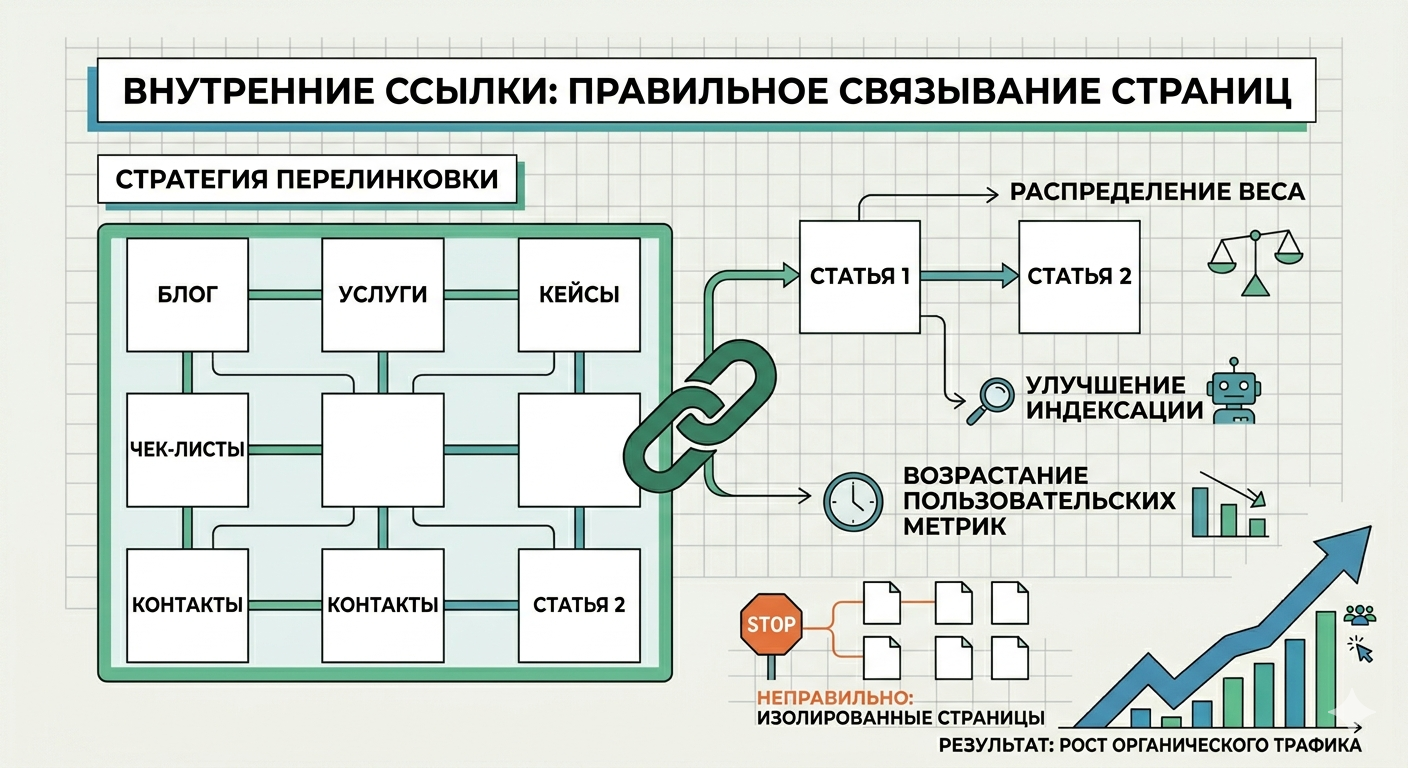
Internal links: how to link pages correctly
Internal linking is an important element of website SEO optimization. It helps search engines better understand the site structure and makes navigation easier for users. Correct use of internal links allows you to improve the indexing of pages and increase their positions in search results.
What are internal links
Internal links are links that lead from one page of a site to another page on the same site. They create connections between different sections and help users find the information they need faster.
For example, in an article about SEO texts, you can add a link to material about selecting keywords or meta tags.
Why internal linking is needed
A proper internal linking system provides several advantages:
-
improves the indexing of pages by search engines
-
helps distribute the weight of pages within the site
-
increases the time users spend on the site
-
simplifies navigation between materials
The more logical the link structure is, the easier it is for the user and search engines to navigate the site.
How to make internal links correctly
When creating cross-linking, you should follow several rules.
1. Use relevant links
The link should lead to a page that complements the topic of the article.
2. Use a clear anchor
Anchor is the text of the link. It is better to use words that describe the content of the page.
Example:
bad - click here
good - how to assemble a semantic core
3. Don't overload your text with links
Too many links can make an article difficult to read.
4. Link to important pages
Most often, links are placed on the main pages of the site: categories, important articles or service pages.
Common mistakes
When creating internal linking, the following mistakes are often made:
-
lack of links between pages
-
links without clear text
-
too many links
-
links to irrelevant pages
Internal linking is an important SEO tool that helps create a logical website structure. Well-linked pages improve navigation for users and help search engines index content better.
How to create sitemap.xml and why it is needed
What is a sitemap. xml
Sitemap. xml is a special site file that lists all the important pages of your resource. It helps search engines find and index pages faster.
The file is created in XML format and is usually located at:
Search engines such as Google and Yandex use this file as a sitemap. Thanks to it, search robots understand the structure of the site and find new pages faster.
Why do you need a sitemap. xml
1. Speeds up site indexing
When a new page appears on the site, the search robot may not immediately find it. The sitemap tells the search engine that the page exists and needs to be indexed.
This is especially important for:
- new sites
- large online stores
- sites with a large number of pages
2. Helps search robots understand the structure of the site
In the sitemap you can indicate:
- which pages are the most important
- when the page was updated
- how often it changes
This helps search engines better navigate the site.
3. Improves SEO
Having a sitemap. xml does not guarantee high rankings, but it helps:
- index pages faster
- reduce the likelihood of missing pages
- improve the technical SEO of the site
This is especially useful for sites on WordPress, online stores on WooCommerce and large catalogs.
What a sitemap looks like. xml
Simple sitemap example:
<urlset xmlns="http://www.sitemaps. org/schemas/sitemap/0. 9">
<url>
<loc>https://site. com/</loc>
<loadmod>2026-03-20</loadmod>
<changefrequency>weekly</changefrequency>
<priority>1 0</priority>
</url>
<url>
<loc>https://site. com/blog</loc>
<loadmod>2026-03-18</loadmod>
<changefrequency>monthly</changefrequency>
<priority>0 8</priority>
</url>
</urlset>
Subtitle:
- loc — host version
- lastmod — no No more changefreq
- changefreq — request change
- priority — Priority of
priority sitemap
1 pages)Subjects for WordPress, home sitemap Subjects
Subjects:
- Yoast SEO
- Rank Math
- All in One SEO
Rank Math slightly less than
Submitted by user:
Definitions English-Specific
Specify the slightly larger version Subject:
- XML-Sitemaps
- My Sitemap Generator
Вы You can use it, and you can use it for
3 Subject
Not to mention, please For example in the XML language
or in the language:
.- subjects in the context of
- subjects on page name
- references references
description:
How to submit a sitemap to search engines
After creating a sitemap, it is advisable to add it to the panel webmasters.
For Google
Google Search Console service is used.
Need:
- go to section Sitemaps
- insert file address
- click Send
For Yandex
Yandex is used. Webmaster.
There is also a section Sitemaps where you add a link.
What pages should be added to the sitemap
It is recommended to add:
- site pages
- blog articles
- categories
- online store products
No need to add:
- filter pages
- technical pages
- duplicate pages
Common sitemap errors
The most common errors:
- broken links
- pages closed from indexing
- file too large (more than 50,000 URLs)
- sitemap not updated
This is why it is important to check your sitemap periodically.
Sitemap. xml is an important technical file for a website that helps search engines find and index pages faster.
It is especially useful for:
- new websites
- blogs
- online stores
- large projects
The easiest way to create a sitemap is to use a WordPress SEO plugin. This allows you to automatically update the sitemap and keep it up to date without manual work.
What is local SEO and why is it needed?
Local SEO is a set of measures to optimize a website and online presence of a business to attract customers from a specific region. Unlike classic SEO, which is aimed at a wide audience, local SEO helps companies find exactly those users who are nearby and ready to use services here and now.
How Local SEO Works
When a user searches for something like “cafe nearby” or “phone repair in the city,” search engines show results based on his geolocation. Maps, lists of companies and sites that are optimized for local queries appear in the search results.
Local SEO helps your business get into these results by:
- using geographic keywords;
- creating and optimizing a company profile;
- availability of customer reviews;
- correct information about the company (address, telephone, opening hours);
- local content on the site.
Why you need local SEO
Local SEO is especially important for small and medium-sized businesses that operate in a specific city or area. Here are the main advantages:
1. Attracting the target audience
You get visitors who are already interested in the service and are nearby, which means there is a higher chance that they will become clients.
2. Increased trust
Reviews, ratings and relevant information about the company increase user trust.
3. Sales growth
The easier it is for a client to find you and contact you, the greater the likelihood of purchasing or ordering a service.
4. Competitive Advantage
Many companies still underestimate local SEO, which makes it possible to beat competitors.
Who is suitable for local SEO
- restaurants and cafes
- beauty salons
- medical centers
- stores
- service companies
Local SEO is a powerful tool for promoting your business in your region. It helps you be visible to customers at the right time and in the right place, increasing the flow of requests and company profits.
SEO vs contextual advertising - which is more effective for business?
Promoting a website on the Internet is an important task for any business. There are two main ways to attract customers from search engines: SEO promotion and contextual advertising. Many entrepreneurs are wondering what is more effective and whether is worth ordering SEO promotion, or is it better to invest in advertising.
Search engines such as Google and Yandex show users both organic search results and advertisements. Let's figure out how these two methods of promotion differ and which one is more profitable.
What is SEO
SEO (Search Engine Optimization) is a set of works to optimize a website to increase its position in search results.
The main goal of SEO is to rank your website in organic search results so that users can find it for free.
SEO includes:
-
technical website optimization
-
SEO content creation
-
working with keywords
-
on-page optimization
-
getting external links
Many companies prefer to order SEO so that specialists develop a promotion strategy and increase search traffic.
What is contextual advertising
Contextual advertising is paid ads that are shown in search results.
For example, in Google such advertising works through the Google Ads system, and in Yandex - through Yandex Direct.
Ads are shown for specific keywords.
Advantages of contextual advertising:
-
quick start
-
instant traffic
-
precise targeting capability
However, this method also has disadvantages.
The main differences between SEO and contextual advertising
Speed of results
Contextual advertising starts working almost immediately after launch.
SEO takes time. Typically, the first results appear within 3–6 months.
But after a site reaches the top, it can receive stable traffic for a long time.
Promotion cost
Contextual advertising works on the principle of pay-per-click.
The more competition for a keyword, the more expensive it costs to visit the site.
SEO requires investment in optimization, but after the site reaches the top traffic becomes shareware.
This is why many companies decide to order SEO promotion.
Long-term effect
Contextual advertising only works as long as the budget is paid.
If you stop the advertising campaign, the flow of customers immediately stops.
SEO works differently. Even after active work is completed, the site can retain its position for a long time.
User Trust
Many users trust organic search results more than advertisements.
Therefore, sites that are in the top of search results receive more trust and clicks.
When is the best time to use SEO
SEO is suitable if you want:
-
get consistent organic traffic
-
reduce advertising costs
-
develop the site in the long term
-
increase user confidence
In such cases, it is better to order SEO promotion and gradually develop the site.
When is it better to use contextual advertising
Contextual advertising is useful if you need:
-
get quickly clients
-
test a niche
-
promote a promotion or new product
-
get traffic to a new site
Advertising helps you quickly launch sales.
The best solution is to use both methods
Many companies use a combination of SEO and advertising.
Contextual advertising gives quick results, and SEO ensures long-term traffic growth.
This strategy allows you to get customers both immediately and in the future.
SEO and contextual advertising are two effective tools for website promotion. Advertising helps you quickly attract customers, while SEO ensures long-term traffic from search engines.
Tip: the best results are usually achieved by combining SEO and contextual advertising - this allows you to get customers both immediately and in the long term.
Why does a business need an SEO website audit?
On the modern Internet, competition between sites is constantly growing. To receive customers from search engines, the site must be properly optimized. This is why many companies conduct a SEO audit of their website before ordering SEO promotion.
SEO audit helps identify errors that prevent a website from ranking high in search engines such as Google and Yandex.
What is an SEO website audit
SEO audit is a comprehensive analysis of a website that identifies technical errors, problems with content and factors affecting positions in search results.
The main task of an SEO audit is to understand:
-
why a site ranks poorly
-
what errors hinder promotion
-
what improvements will help increase traffic
After the audit, it becomes clear what steps need to be taken to improve the site's position.
When a business needs an SEO audit
SEO audit is especially useful in the following situations:
1. The site is not receiving traffic from search engines
Even if the site has been around for a long time, it may not be receiving visitors from search.
2. The site's position has dropped sharply
Sometimes a site loses position due to Google or Yandex algorithm updates.
3. Before starting SEO promotion
Before ordering SEO, specialists usually conduct an audit to determine a promotion strategy.
4. After developing a new site
New sites often have technical errors that interfere with indexing.
What is included in a website SEO audit
A professional SEO audit includes the analysis of several important factors.
Technical audit
Checked:
-
site loading speed
-
mobile adaptation
-
page indexing
-
presence of broken links
-
correctness robots. txt and sitemap
Technical errors can seriously reduce a site's position.
Site structure analysis
During the audit, specialists check:
-
section structure
-
correctness of headers H1–H3
-
internal linking
-
ease of navigation
Proper structure helps search engines understand your site better.
Content Analysis
Content plays a key role in SEO.
Checked:
-
text uniqueness
-
use of keywords
-
quality and usefulness of information
-
meta tag optimization
If the content is weak or is not optimized, promotion will be difficult.
Link Profile Analysis
Links from other sites remain an important ranking factor.
During an SEO audit, the following is checked:
-
number of links
-
quality donors
-
presence of spam links
Tools are often used to analyze links:
-
Ahrefs
-
SEMrush
-
Serpstat
What results does an SEO audit give
After the audit, a business receives:
-
list of errors site
-
optimization recommendations
-
promotion strategy
-
traffic growth forecast
This allows to order SEO promotion more effectively and avoid unnecessary expenses.
Is it possible to do an SEO audit yourself
You can do a basic audit yourself using the following tools:
-
Google Search Console
-
Screaming Frog SEO Spider
But a professional audit is usually performed by SEO specialists, since it requires an in-depth analysis of the site and competitors.
Tip: Regular SEO audits help keep your website in good condition and maintain high rankings in search results.
SEO for Beginners: A Step-by-Step Guide
Search engine optimization of a website is one of the most effective ways to attract customers from the Internet. Many website owners are wondering: how to bring a website to the top of search engines and whether it is worth ordering SEO from specialists or whether you can start on your own. In this article, we will understand what SEO is and how to properly start website promotion.
What is SEO
SEO (Search Engine Optimization) is a set of works to optimize a website, aimed at increasing its position in search engines such as Google and Yandex.
The main goal of SEO is to make a website as useful and understandable as possible for users and search engines.
Result of competent SEO:
-
increase in site rankings
-
increase in organic traffic
-
more clients and sales
-
stable flow of visitors without advertising
That's why many companies prefer to order SEO promotion so that specialists carry out comprehensive site optimization.
Step-by-Step Guide to SEO for Beginners
1. Analysis of the niche and competitors
Before starting promotion, it is important to understand:
-
which sites are already in the top
-
which keywords are used competitors
-
what content is published by niche leaders
To analyze, you can use the following tools:
-
Ahrefs
-
SEMrush
-
Serpstat
They help you find popular queries and determine a promotion strategy.
2. Collecting Keywords
Keywords are queries that users enter into a search engine.
Examples of key phrases:
-
order SEO
-
order SEO promotion
-
SEO website promotion
-
SEO services
-
SEO website optimization
The correct selection of keywords is the basis for successful promotion.
3. Website structure optimization
Search engines love a logical website structure.
Example of the correct structure:
-
Home
-
Services
-
Blog
-
Cases
-
Contacts
It is also important to format it correctly:
-
Title
-
Description
-
H1-H3 headers
This helps search engines understand the content of the page.
4. SEO optimization of content
Content is one of the main ranking factors.
To rank your article well:
-
use keywords (for example, order SEO)
-
write useful and unique text
-
add subheadings
-
use lists
-
add images
Search engines, especially Google, love useful content that answers users' questions.
5. Technical website optimization
Technical SEO includes:
-
site loading speed
-
mobile adaptation
-
correct indexing of pages
-
absence of broken links
To check your site you can use:
-
Google Search Console
-
Screaming Frog SEO Spider
6. Off-Page SEO (Links)
Outbound links remain an important ranking factor.
Ways to get links:
-
blog posts
-
website directories
-
guest articles
-
PR publications
The more quality links to a site, the higher the trust of search engines systems
7. Constant development of the site
SEO is not a one-time job. For stable growth you need:
-
regularly publish articles
-
update old content
-
analyze site positions
-
work with behavioral factors
Many website owners prefer order SEO promotion so that specialists constantly develop the site and maintain its position.
Should I order SEO or do it myself
If the site is small, you can start SEO yourself.
But if you want:
-
quickly get to the top
-
receive stable traffic
-
overtake your competitors
it’s better to order SEO promotion from specialists.
Professional SEO includes:
-
site audit
-
promotion strategy
-
technical optimization
-
SEO content creation
-
work with links
Publish useful blog articles regularly - this is one of the most effective ways to get free traffic from search.
White, gray and black hat SEO - what to choose?
In the world of SEO promotion there are three main approaches: white, gray and black hat SEO. Each of them has its own advantages and risks. To choose the right strategy, it is important to understand how they work and what goals you have for your website.
1. White Hat SEO
White Hat SEO are legal promotion methods that fully comply with search engine rules.
Key elements:
-
Quality content that is useful to users.
-
Optimization of meta tags and site structure.
-
Natural link building.
-
Improving user experience (UX).
Pros: secure, steady traffic growth, long-term results.
Disadvantages: requires time and effort, results do not appear immediately.
White hat SEO is ideal for companies that want to entrust their promotion to professionals and order SEO services with a guarantee of security.
2. Gray Hat SEO
Grey Hat SEO are methods that are not directly prohibited, but can be risky:
-
Paid links from sites of average reputation.
-
Use of partially automated content.
-
Easy manipulations with internal linking.
Pros: quick effect with moderate risks.
Disadvantages: possible penalties from search engines, especially Google.
Gray SEO is suitable for experienced professionals who understand how to balance fast results with site security.
3. Black Hat SEO
Black Hat SEO are prohibited methods aimed at rapid growth of positions:
-
Hidden text and keywords.
-
Bulk purchase of links from low-quality sites.
-
Spam and click fraud.
Pros: Instant results.
Disadvantages: high risks of site blocking, loss of user trust.
Black hat SEO is only suitable for short-term projects where the consequences are not critical.
How to choose a strategy for your website?
-
Define your business goals: long-term growth or quick results.
-
Assess your budget and resources.
-
If you want safe promotion, choose white hat SEO.
-
If you are ready to take moderate risks to accelerate growth, you can use elements of gray SEO.
-
Black hat SEO should be used extremely carefully and only for experiments.
Ordering SEO services from professionals helps you combine the best methods and achieve top positions without risking your site.
In 2026, SEO promotion requires a balanced approach. White hat SEO remains the most secure and stable. Gray SEO is a trade-off between risk and speed. Black hat SEO is for the brave and ready to face the consequences. The choice depends on the goals and strategy of your business!
Why does a business need SEO and why it is worth ordering SEO promotion
Today, almost any business is searched through the Internet. When a person enters a query into Google Search, they typically select sites from the first page of results. That is why SEO website promotion has become one of the most important investments for businesses.
What is SEO website promotion
SEO (Search Engine Optimization) is a set of works aimed at improving the site's position in search engines.
The main task of SEO is to make sure that the site is found for the right queries.
For example:
- order SEO promotion
- SEO website promotion
- website promotion in Google
- website promotion for business
- SEO optimization services
If the site is optimized correctly, it begins to receive free organic traffic from search.
Why you should order SEO promotion
Many website owners try to promote their website on their own. But professional SEO website promotion gives much better results.
Benefits:
Increased website traffic
Increased sales and applications
Improved positions in search engines
Attracting the target audience
When you decide to order SEO promotion, experts analyze:
- site structure
- keywords
- competitors
- technical errors
- content quality
After this, a strategy for promoting the site on Google is developed.
What work is included in SEO
Professional SEO services usually include:
- Site analysis (SEO audit)
- Keyword selection
- Technical optimization
- Page optimization
- Creating SEO content
- Getting links
All these stages help improve website promotion and increase its visibility in search.
How much does SEO promotion cost? pages
But in most cases, ordering SEO promotion is much more profitable than constantly paying for advertising.
Result
If you want to receive a stable flow of clients from the Internet, the best solution is to order SEO website promotion from specialists.
Competent SEO optimization allows you to bring your website to the top of search engines and ensure constant business growth.
Quick Purchase
Leave your contact details, and we will contact you to complete your order.